The Intriguing World of Vintage Prints: Unraveling Their Hidden Stories and Descriptions

Sometimes we are lucky enough to find a contemporary description attached to a rare vintage print. These descriptions can be humorous, enlightening, technical, or even salacious. They bring the engraving to life, offering a glimpse into the past even when the text is incomplete or fragmented. This connection between image and words transforms a static print into a vivid story, inviting us to explore history through the eyes of those who witnessed or even lived it.

How Descriptions Add Depth to Vintage Prints
Vintage prints often come from eras when photography was rare or nonexistent. Artists and engravers captured scenes, people, and events with painstaking detail. However, without context, these images can feel distant or mysterious. A contemporary description, written at the time the print was made or shortly after, can:
Explain the subject matter or event depicted
Provide background on the artist or engraver
Share anecdotes or cultural references relevant to the image
Offer technical details about the printing process or materials used
For example, a print showing a bustling 18th-century market might include a note about the types of goods sold, the social classes present, or even a humorous comment about the vendors’ bargaining tactics. This additional layer of information helps modern viewers understand the scene beyond the visual appeal of the print they're buying.
Examples of Engravings Brought to Life by Text
One evocative specimen is a print of the 19th-century obsession with scientific experiment and seeking the curious. The engraving below shows The Long Room of the Gallery of Practical Science on Adelaide Street off London's Strand. Described as 'a noble apartment, lighted by ground glass domes, and fitted up in chaste style throughout', it was its contents of invention, science and amusement that excited 19th century visitors – 'the first...of its kind established in London'.
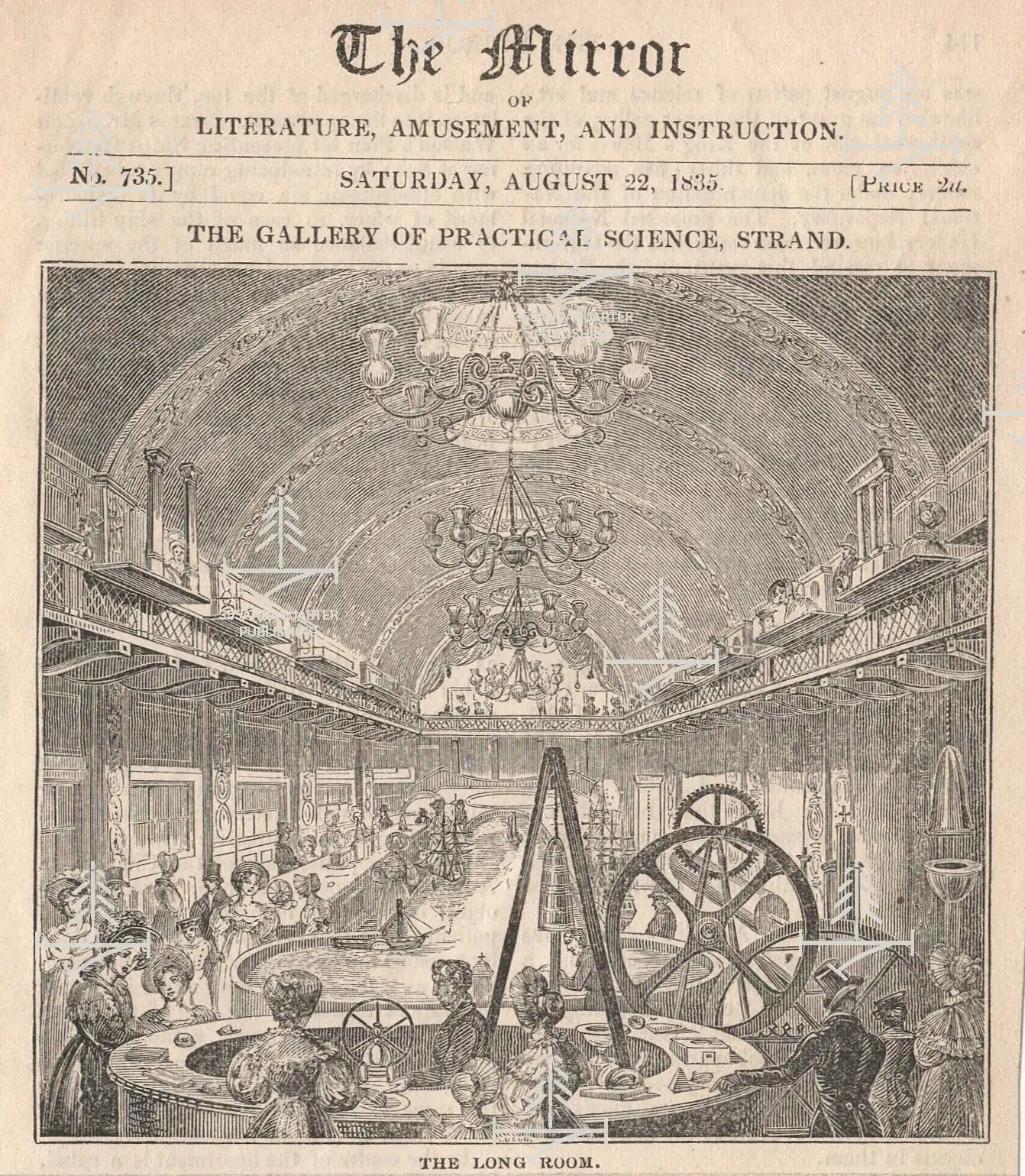
The gallery, along with ten other apartments, were filled with a world of wonders...'Mr. Austin’s classic [Artificial Stone] specimens; as the Dog of Alcibiades, the Crouching Venus, Gothic Font, (from that in Henry VII.’s Chapel, and five busts. Here also are Bielefield’s architectural ornaments in papier maché, such as have been employed in the temporary Houses of Parliament, and the Pantheon, Oxford-street. Pitt’s Apparatus for heating air without deteriorating it, by passing hot water or steam in pipes to a hollow pedestal; this contains a spiral channel, through which the air received at the bottom rises by rarefaction, and is discharged at the top, through ventilators, into the apartment.'
In an age of dangerous sea travel, when 564 merchant ships and vessels were lost in one year (1828)...'Mr. Ralph Watson’s Plan for preventing Ships foundering at Sea; by introducing copper tubes filled with atmospheric air, equal by its displacement of water, in case of the ship filling, to counterbalance so much of the specific gravity of the ship and her contents as would otherwise cause her to sink. Among the exemplifications of the plan, is a sectional model of a portion of an 80-gun ship, representing the parts of the ship, in which it is proposed to arrange the “ Safety Tubes.”'
While back on land, there lay...'Dr. Amott’s Hydrostatic Bed for Invalids; the object of which is to prevent the fatigue of patients lying in one position, which is done by causing the bed to float on water as completely as if the Atlantic were under it; whilst the patient reposes on the face of the water, like a swan on its plumage, without sensible pressure anywhere, and almost as if the weight of the body were annihilated. Along the same side of the room are cases, and above them are various models.'
Back here in the Long Room, architectural marvels really pushed the boundaries of innovation. No expense or imagination was spared...
'In the centre..is a canal, 70 feet in length, having a circular reservoir at each end, and containing 6,000 gallons of water, for experiments with models of steam- boats, steam-paddles, &c. Here sails, in mimic life, a steam-boat, four feet in length, fitted with clock-work machinery; whilst Perkins’s Patent Paddle-wheel placed at the stern, propels the boat; and at the head, drags the boat after it; in either case preventing injury to the banks, if employed in canal navigation. Here may sometimes be seen Canning’s Life-raft.'
And there was yet more...'Another interesting and picturesque object in this canal, is a small but exact model of Eddystone Light-house, “that splendid triumph of Smeaton’s architectural skill and persevering industry, in opposition, as it were, to the united efforts of the elements and other most unparalleled difficulties.” On the right side of the canal are models of different vessels.'
The Mirror of Literature, Amusement and Instruction, 22 Aug 1835
Another enthralling example is this engraving of the Gate of St Bartholomew’s Hospital (the world renowned St Barts), again in London.
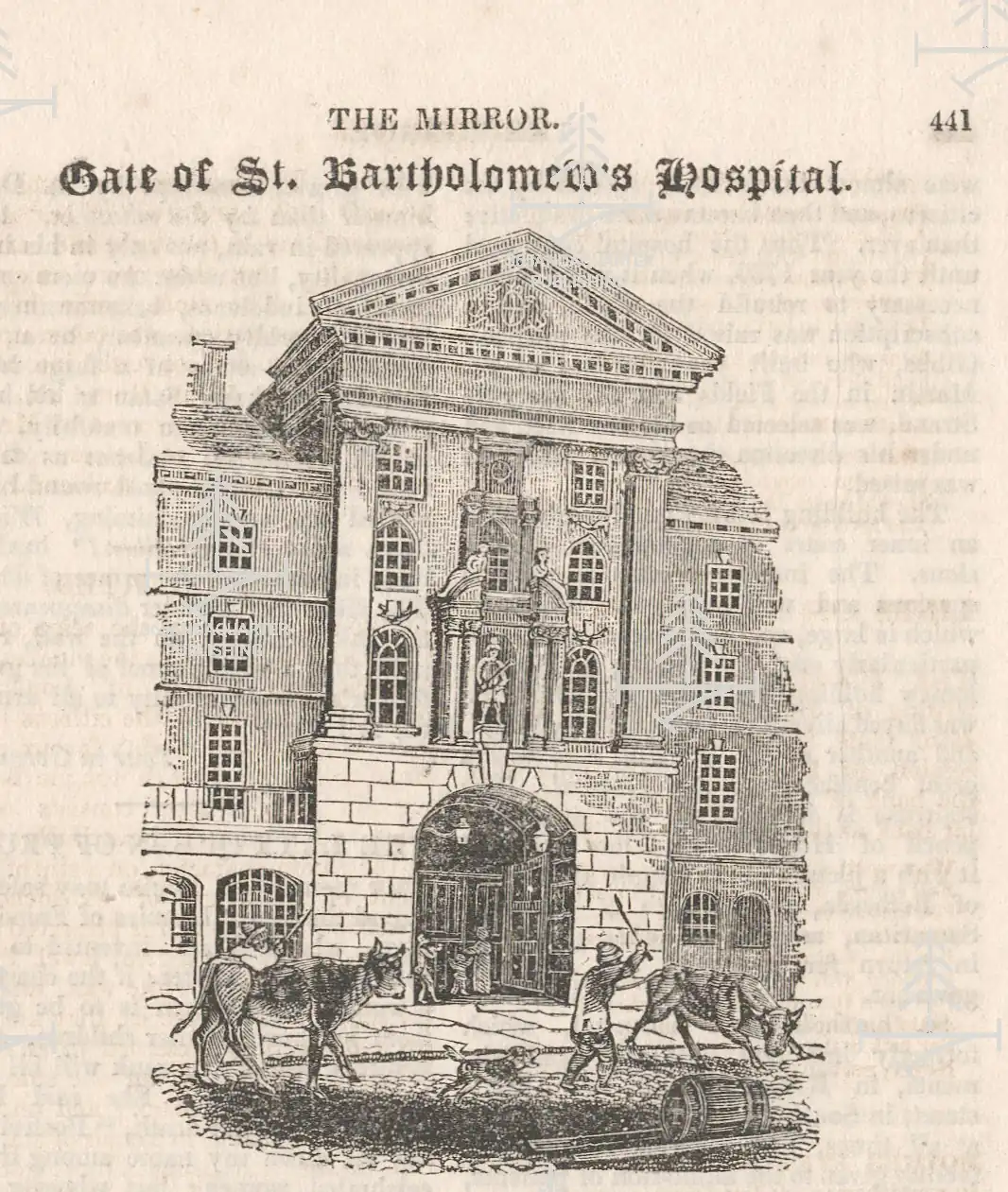
Its principal entrance in Smithfield is shown here, described in the accompanying text (not shown) as...‘a fine specimen of Doric architecture. It was erected in 1702; and consists of a large arch, over which is a statue of Henry VIII. placed between the Corinthian pillars,— Supporting a circular pediment adorned with two figures, emblematical of Sickness and Lameness.’
It further revealed that St Barts had an ancient history, claiming that perhaps its very existence...‘as a benevolent institution [boasted] an antiquity of more than seven centuries...having been originally founded in 1102, by Raherus, who is said to have been a minstrel to King Henry I.’
It was established, they went on, to serve...‘“brethren and sisters, sick persons, and pregnant women”.’ In the year 1660...‘[it] maintained upwards of 300 sick or lame per-sons, at an expense of £2,000 a year..[having] escaped the dreadful conflagration [that year], although several houses constituting a portion of its revenues were destroyed.'
The Mirror of Literature, Amusement and Instruction, 22 Aug 1835
Facing the Challenge When Descriptions Are Missing
Unfortunately, many (most?) vintage prints lack complete descriptions. Sometimes the text is damaged, faded, or only partially preserved. This can leave historians and collectors guessing about the print’s full meaning - or, as we do, researching deep into the archives. In such cases, we often rely on clues within the image itself, such as clothing styles, architecture, or known historical events, to piece together the story.
The rest, as they say, truly is history.




Comments